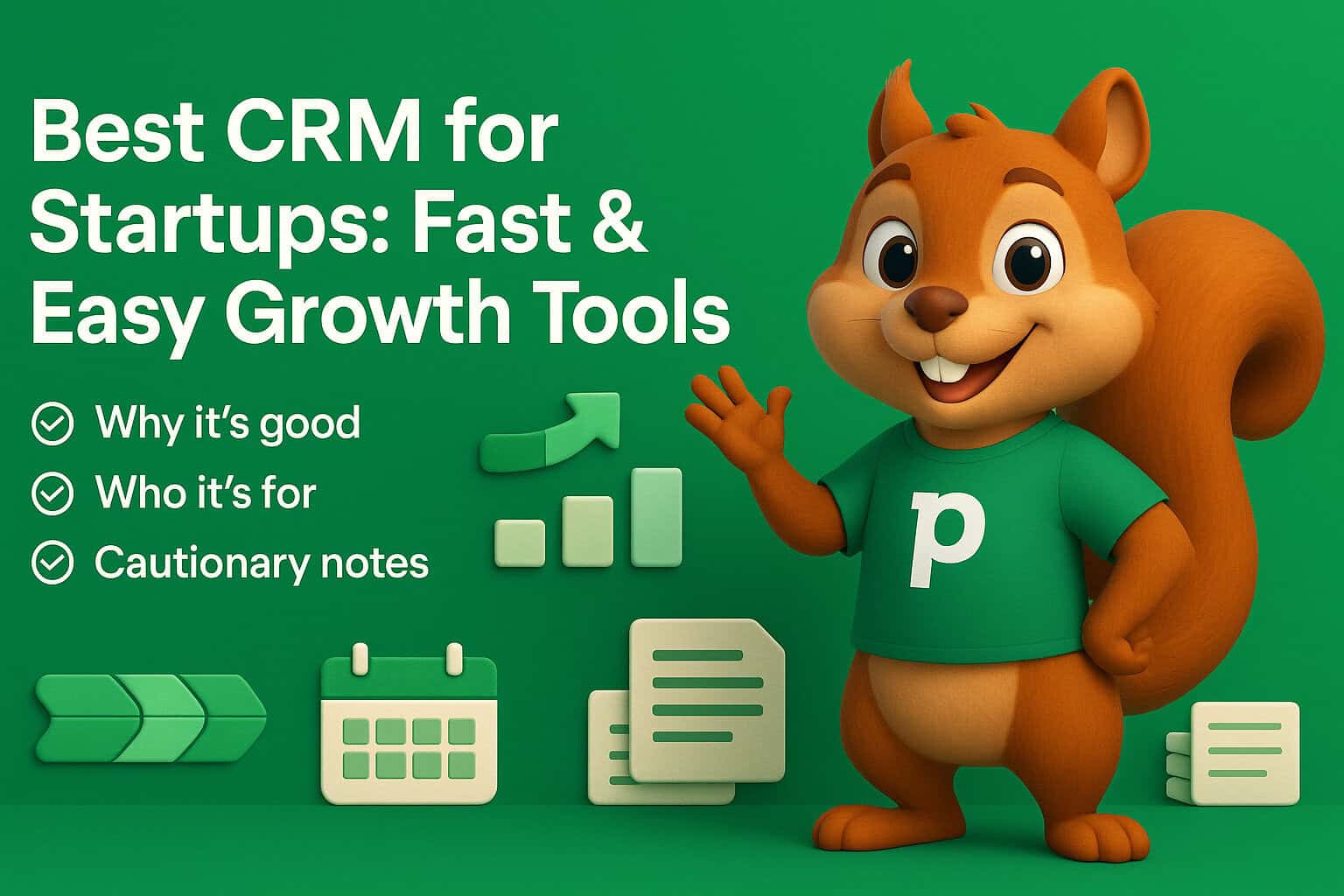
Best CRM for Startups: Fast & Easy Growth Tools
If you have a B2B startup, then you know that it is moving quickly. I
t brings a new challenge every day. Lead management, follow-ups, and customer engagement are your top priority. Some days, it feels like you’re doing so many things at the same time.
You’re building something important, but without structure, even the best ideas can lose momentum.
Startups aren’t just smaller versions of big businesses. They’re built to grow fast, break new ground, and stretch every dollar and deadline.
But the real challenge is managing everything: sales, marketing, customer support, and even funding.
That’s when a CRM (customer relationship management) becomes an essential tool for your startups.
It helps you plan leads, deals, follow-ups, and closings, plus make your customers happy, in one location.
But come on!
Not just any CRM can improve your startup’s growth. Smart startups also require smart systems to keep pace.
You want the highest-performing CRM for startups that can manage your mess and your budget for growth.
For startups, the right CRM is not an extra. It makes the difference between continued growth and missed opportunities.
According to a 2024 Capterra report, 78% of startups that used a CRM in their first year saw a 30% increase in lead conversions.
So, how do you select the best CRM software for startups?
In this blog, we will discuss the best CRM for startups.
Let’s dive into the blog to find out how to choose the best CRM system for startups.
Why CRM Is Necessary for Startups?
Imagine this:
Your startup just went viral on LinkedIn. Your inbox is flooded. You’ve got demo requests, investor interest, and B2B prospects booking intro calls.
Exciting? Absolutely.
Three weeks from now. Half of those leads are cold. Because you didn’t follow up with the investor, you lost the potential client in the inbox.
You didn’t lose the deal because your idea lacked value. You lost it because you were doing 20 things at once, and something slipped.
This is the growth trap many startups fall into.
You might be outreaching like a rockstar. You might be generating leads magnetically.
But if you’re not in a position to sort, prioritize, and act quickly, those leads will go away and be gone for good. And they won’t be coming back.
That’s where a CRM can be a game-changer. It saves your startups.
Here’s what CRM does for your startups:
- Keeps all customer interactions, emails, phone calls, notes, and meeting records in one handy place
- Maps lead through your sales pipeline so you’ll know who’s on the line of closing, who needs a gentle message, and who ghosted
- Streamlines work, such as follow-up emails, lead reminders, lead assignment, and call scheduling
- Provides you with insights into who’s purchasing, when they’re purchasing, and most importantly, why they’re not
What a Startup Truly Needs is a CRM That’s…
- Easy enough to set up, where you don’t need to read a 50-page manual or watch 7 YouTube videos
- Scalable enough to grow as fast as your business, without breaking things in the process
- Cheap enough so that it won’t need much money to purchase, or leave you starving again
- Simple to use or easy so that your sales reps want to use it.
Best CRMs for Startups in 2025 (Ranked & Reviewed)
Selecting a CRM for your startup is sort of like online shopping.
Some CRMs are perfect on paper, but as soon as you try to make them work, red flags!
So, how do you pick the one that won’t ghost you when things get a little complicated?
We’ve made an analysis and listed the 5 best CRM for startups in 2025, so let’s get started.
1. Salesforce: The Industry Titan

Salesforce Key Points:
- Endless customization options
- Integrates with everything (if it has an API, it plugs in)
- State-of-the-art analysis and AI-driven insights
Why Startups Sometimes Love Salesforce:
Salesforce is the OG; giants like Amazon, Spotify, and American Express rely on it.
If your startup just raised a Series A and you’re growing your sales team from 5 to 50, Salesforce might be the CRM you need.
It can model sophisticated workflows, customer journeys, partner tracking, you name it.
But.
The Catch of Salesforce?
- It’s not for newbies
- Setup takes weeks (or months)
- Plans start at premium, and add-ons pile up fast
- You’ll likely need an in-house CRM admin or an external advisor to maintain it
Salesforce Advantages:
- Extremely versatile, you can set it up for any type of sales model
- Ideal for multi-department orgs that need super granular reporting
- Offers enterprise-grade data security, compliance, and analytics
Salesforce Judgment:
Salesforce is a monster, but only if you can dedicate the time. Best for VC-backed startups with high-growth plans, complex pipelines, and people to deal with them.
2. HubSpot CRM: The Sales Darling of Startups
HubSpot CRM Key Highlights:
- 100% Free version (forever)
- Blinder UI with zero learning curve
- Email tracking, sequences, and scheduling
- Marketing tools built-in (forms, landing pages, automation)
Why Startups Love HubSpot CRM:
Picture this: You’re wearing multiple hats: founder, marketer, salesperson, and maybe even part-time customer support.
HubSpot CRM is like hiring a mini marketing and sales assistant. It helps you to organize your entire outreach workflow.
You can:
- Set up a full sales pipeline in under 30 minutes
- Create branded email sequences and track opens
- Use the meeting scheduler to book demos without a dozen back-and-forths
- Even spin up a landing page or a pop-up form for your MVP launch
And the best part? It’s all in one place. One login. One dashboard.
Benefits of HubSpot CRM (Real Startup Wins):
- Free plan is surprisingly generous, ideal for startups with no budget
- Perfect for solo founders or 23-person teams handling outreach + marketing
- Great UI and onboarding; you’ll feel like a pro in a day
- Helps to get marketing + sales on the same page in a single tool (no need to use two tools)
But wait, that free plan? It’s a gateway drug.
HubSpot CRM Disadvantages:
- The moment you need automation, sophisticated reporting, or custom properties, you’re in expensive territory in an instant
- Reporting is quite restrictive unless you pay extra
Pro Tips for HubSpot CRM:
HubSpot CRM is best for new founders. It provides you with a set of tools addressing both sales and marketing basics. Just be ready to pay when you start scaling.
3. Pipedrive: Visual, Sales First, and Startup Ready
Pipedrive Key Highlights:
- Clean, visual drag-and-drop pipelines
- Automation workflows are baked right in
- Good mobile experience
- Low-entry cost plans
Why Startups Love Pipedrive:
Pipedrive doesn’t try to do it all, and that’s why it’s so strong.
This CRM is built for startups in the trenches, hustling leads, booking demos, and attempting to hit revenue milestones. It’s a sales-first app, top to bottom.
Use cases founders love:
- Make deals flow through your pipeline like Trello cards
- Automatically send follow-up reminders at the deal stage
- Know which prospects to prioritize without scrolling through a huge Excel sheet
- Have it all at your fingertips from your phone while pitching out of a cafe or coworking space
Pipedrive Features:
- Intuitive to use, your team won’t neglect it
- Robust automation with minimal setup (no devs required)
- Extremely visual pipeline keeps your attention on moving deals, not tool management
- Mobile app is a godsend for remote sales teams
Pipedrive Disadvantages:
- No perpetually free plan (but a 45-day free trial is available)
- Fewer marketing tools baked in than HubSpot
- You’ll need Zapier or integrations for email marketing & landing pages
Pro Tips for Pipedrive:
Pipedrive is the perfect CRM for sales-focused startups who must move fast, remain lean, and do not desire the bloat of larger systems. Great for bootstrappers who require clarity and control.
Ready To Scale Your Startup From Zero?
Join Pipedrive CRM Today And See How Quickly Your Startup Explodes.
4. Insightly: Project Management + CRM in One
Insightly Key Highlights:
- Integrating Project management features
- Assignments, milestones, and pipelines
- Google Workspace + Outlook integration
Why Startups Love Insightly
Running a client services startup? You’re probably juggling both sales and project delivery at the same time.
That’s where Insightly comes in.
- Whereas most CRMs provide just that, Insightly offers:
- One dashboard to monitor leads + assign project work
- One hub for notes, files, and timelines
- Transparency across sales AND fulfillment teams
- Ideal for agencies, consultancies, or productized service businesses.
Insightly Pros:
- Rolls up CRM + project tools into one location
- Excellent for handling client onboarding, project delivery, and upsells
- Seamless integration with Google Workspace, Dropbox, Xero, etc.
Insightly Cons:
- UI is a bit dated, especially after using something like Pipedrive
- Steep learning curve compared to HubSpot or Zoho
- Not ideal if you’re only interested in outbound sales
Verdict about Insightly:
Insightly is perfect for service-based startups (consultancies, agencies, etc.) that need task and deal management all in one. Not for pure SaaS or high-velocity sales teams.
5. Zoho CRM: Inexpensive & Surprisingly Feature-Rich
KZoho CRM ey Highlights:
- Good free plan with lead tracking, automation, and scoring
- Social media + email integrations
- Automation of workflows and analytics
Why Startups Love Zoho CRM
Zoho CRM punches well above its weight class.
Perfect for early founders who need to abandon spreadsheets but still need affordable tools that grow with them. Especially great for emerging markets and solopreneur teams.
You can do the following with Zoho:
- Automatically assign leads to your sales team
- Create email templates and track performance
- Integrate with social channels to understand customers
Zoho CRM Pros:
- Lots of features for not a lot of spending
- Modular, you choose and select apps from within the Zoho suite (e.g., Projects, Books, Campaigns)
- Best for nontraditional CRMs like real estate or service companies
Zoho CRM Con:
- User interface is a bit dated compared to HubSpot or Pipedrive
- Can be overwhelming because of the number of options
- Not all integrations are as plug-and-play out-of-the-box
Verdict about Zoho CRM:
Zoho CRM is ideal for bootstrapped startups that require good features without overspending. Excellent choice for founders who are not U.S.-based or who are growing slowly but surely.
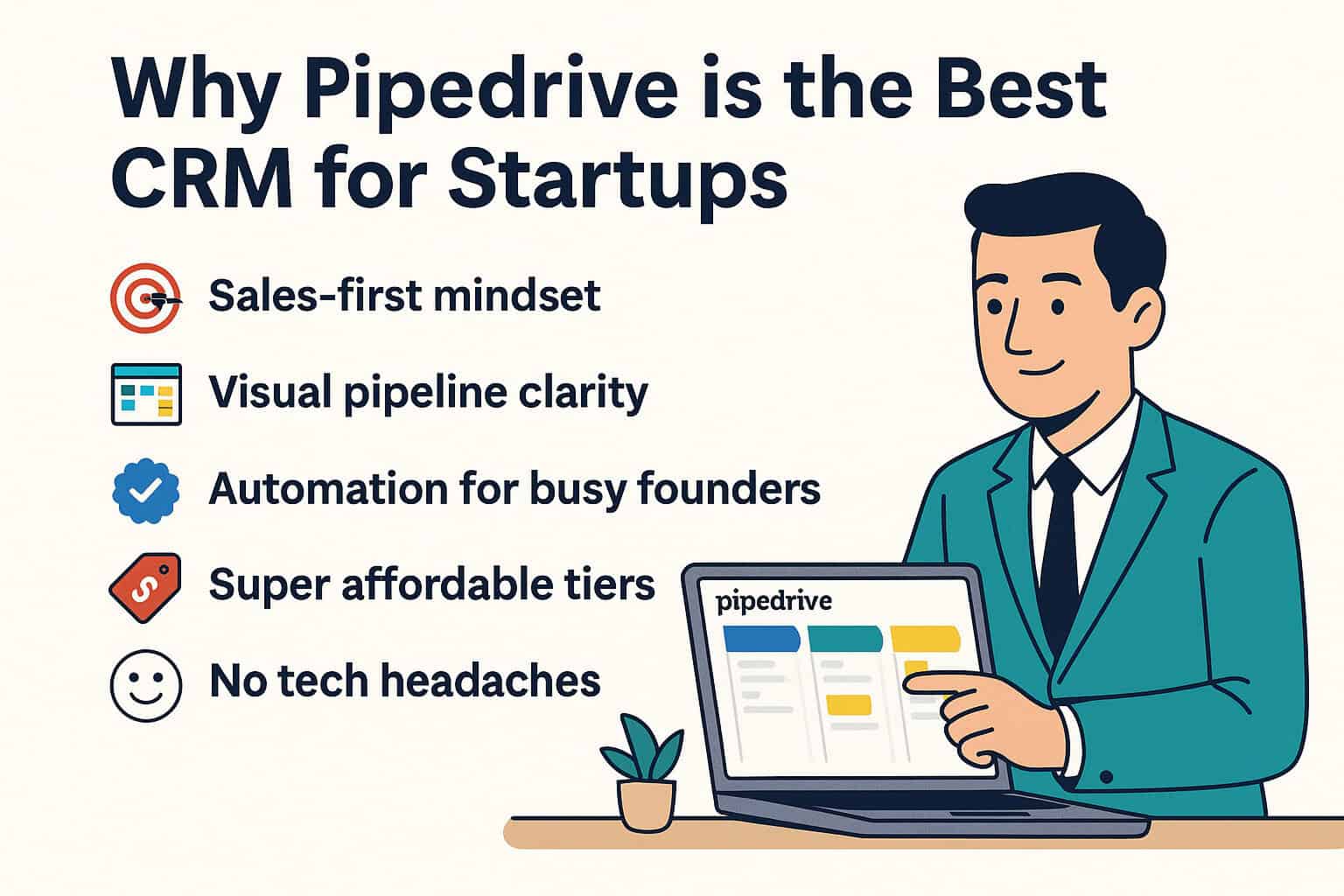
Why Pipedrive is the Best CRM for Startups
Let’s be real, most CRMs weren’t designed for you.
They were designed for plump enterprise sales teams with three layers of management, 50+ reps, and a full-time admin just to keep up with the CRM itself.
That’s not your world.
You’re an early-stage founder of a pre-revenue startup, closing deals over Zoom calls, handling outreach, demos, and growth tests.
You need something that sells without turning your day into a data-entry marathon.
And Pipedrive delivers.
Pipedrive Was Built for Hustlers!
Not for suits.
Not for corporate silos.
But for the early-stage founder on the quest for product-market fit, fueled by coffee, instincts, and Google Sheets.
If CRMs were human beings, Pipedrive would be that friend who gets you on point, on track, and grinding at maximum capacity.
Fact: Pipedrive was built by salespeople for salespeople. The creators were annoyed with those CRMs that made selling harder, not easier.
And that means everything.
Why Pipedrive Wins for Startups: A Deep Dive
Here’s how we can unravel exactly how Pipedrive became the startup CRM secret weapon.
1. SalesFirst Mindset
Other CRMs are trying to do everything for everyone: a marketing platform, support platform, and ops center. Pipedrive has a single goal in mind: to help you sell more.
It isn’t weighed down by content marketing campaigns, A/B testing, or landing page creation.
You’re not going to be swimming in an ocean of tabs, charts, and “premium add-ons.”
Instead, you open it up and zap. You’re displaying your deals. Your tasks. Your pipeline. No distraction. Just action.
Why these matters:
- Speed and ease win out over complexity at the early-stage sales.
2. Visual Pipeline Clarity
One of the best things about Pipedrive is how visually simple it is to use.
All your leads are waiting on a drag-and-drop board.
You can move deals from “Qualified” → “Demoed” → “Negotiation” → “Won” in one click.
It’s simple, organized, and even fun to use.
No more burrowing in spreadsheets or endless dropdowns. You always know what’s in every deal—and the next action to take.
Bonus: You can set up several custom pipelines (sales, onboarding, investor outreach) without learning anything new.
3. Automation That Doesn’t Require a PhD
All CRMs claim automation but hide it in convoluted settings or pricey add-ons.
Not Pipedrive!
You can set it up with only a few clicks:
- Send automated responses after form submissions
- Remind to follow up after X days
- Send emails when a deal reaches a new stage
- Automatically assign tasks to your team
You save dozens of hours per week without writing a line of code or bringing on a CRM expert.
Tip: Their “Workflow Automation” feature is a breeze, bulletproof, and comes even in their midrange plans.
4. Super Affordable Tiers That Scale With You
Startups are obsessed with software that grows with them, and Pipedrive nailed it.
- The lowest tier begins at an absolute $14/month/user
You get all CRM functionality without credit card jubilation
When you expand, features like AI sales robots, detailed reporting, and team goals arrive unlocked
- Compare that to other CRMs that put core features behind $100+/month paywalls.
Tips: You can scale a 7-figure sales machine on Pipedrive’s lower plans. No joke.
5. No Tech Headaches. Like, Zero.
This one’s underrated.
With Pipedrive:
- Setup is less than an hour, even for non-tech founders.
- No engineers needed.
- No 6-part onboarding webinar required.
It integrates smoothly with tools like Gmail, Slack, Zoom, Calendly, Zapier, Mailchimp, and more. So it fits into your existing workflow without friction.
It’s “plug and play” at its finest. You’ll be lively and productive before your coffee goes cold.
Bonus Goodies Worthy of a Shoutout
- Mobile App: One of the best in the CRM space, great for on-the-go sales
- AI Sales Assistant: Gives real-time nudges on which deals to prioritize
- Reports & Dashboards: Crisp, customizable, and dead simple
- Marketplace: 300+ integrations including Slack, PandaDoc, Xero, and more
Bottom Line: If You’re Selling, Pipedrive Is Helping
Pipedrive doesn’t try to be everything. It just does one thing well:
It helps startups sell faster, smarter, and with fewer headaches.
So if you’re a:
- SaaS founder trying to get your first 100 customers
- Marketing agency owner juggling inbound leads
- B2B startup chasing demos like your runway depends on it…
- Pipedrive is the no-brainer CRM you’ve been looking for.
Ready to Try Pipedrive?
Don’t Scale Without a CRM
Your startup growth isn’t fast; it’s systems.
And sticky notes, spreadsheets, and Slack threads will start you off, but won’t scale you.
A solid CRM is your growth foundation. It keeps you:
- Sell smarter
- Follow up faster
- Stay focused
You don’t have to be an expert in all the tools. Just choose the right one and scale with it.
Choose a CRM that works as hard as you. Try a few, start small, and grow smart.
Ready To Scale Without The Stress?
Try Pipedrive For Free Today And Discover How Much Easier Your Sales Process Can Be!
FAQs about Best CRM for Startups
What is the easiest CRM to use for startup founders?
HubSpot and Pipedrive are very easy to use. Pipedrive is sales-focused, and HubSpot has more advanced features.
Can a CRM be purchased for free as a startup?
Yes. HubSpot and Zoho both have decent free versions. Just be aware of limits on users or features when you grow.
What is the best CRM for B2B startups?
A: Pipedrive is great for handling lengthy B2B sales cycles. Salesforce is great, too, but only if you’re subsidized and someone is operating it for you.
What is the best value for money CRM?
Zoho is budget-friendly and packed with features. Pipedrive is great, middle of the road cost-wise, and incredibly functional.
When do I invest money in a paid CRM?
As your lead volume increases and follow-ups begin to slip through the cracks. That’s your cue to upgrade.